
Berkeley County Court Records After Arrest
Berkeley County court records after a jail arrest begin with a custody event, but they do not stay limited to the jail record. Arresting agencies bring a person to Hill-Finklea Detention Center, booking staff enter the intake data, and the first court step is often a magistrate or bond hearing. South Carolina law generally requires a bond hearing within 24 hours for a person charged with a bailable offense. After that first stage, the formal criminal case depends on the offense level and prosecutor review.
The jail side and the court side answer different questions. The Berkeley County jail inmate records page is the better path for current custody, booking date, arresting agency, and release clues. The Berkeley County jail mugshots page focuses on booking photos and booking images. Court records after an arrest focus on filed charges, case number, hearing dates, bond orders, dispositions, and sentence events.
Find Berkeley Court Records After Arrest
The main online starting point is the South Carolina Judicial Branch Case Records Search. Berkeley County appears as Circuit 9, County 08. The search is a court index, not a jail roster. Use it to look for the court case that follows a Berkeley County arrest, especially when the jail record lists current charges but does not show the later court status.
| Field Label | Type | Required | Search Notes |
|---|---|---|---|
| County | Link, dropdown, or list | Yes | Select Berkeley County, Circuit 9, County 08. |
| Case number | Text | No | Best when copied from bond paperwork, a warrant, a roster entry, or an attorney notice. |
| Party or defendant name | Text | No | Search by last and first name, using careful spelling and name variants. |
| Court type | Filter or link | No | General Sessions and Magistrate records may be reached through separate portal paths. |
| Date range | Date or filter | No | Use the arrest, filing, or court date if known. |
For older records or in-person questions, the Berkeley County Clerk of Court is the local court-record office. The county page identifies Leah Guerry Dupree as Clerk. Berkeley County also lists Magistrate Court at 1003 Highway 52 in Moncks Corner with phone 843-719-4234.
Berkeley Arrest to Court Path
A Berkeley County arrest does not become a final court outcome at booking. The record path is best read as a sequence: arrest, jail booking, bond hearing, prosecutor review, filed charge, case activity, and disposition. Until a disposition appears, the court record is still pending unless the case history says otherwise.
- Check the jail roster if the person may still be in Hill-Finklea custody.
- Search the South Carolina court index by Berkeley County, defendant name, or case number.
- Open the case and compare the charge list to the booking charge shown on the jail record.
- Review bond events, hearing dates, warrants, and disposition entries separately.
The South Carolina Judicial Branch Berkeley courthouse search can help confirm court location context. It is useful when a name search finds a case but the reader needs to understand which Berkeley County court office is tied to the entry.
Berkeley County Prosecutor Records
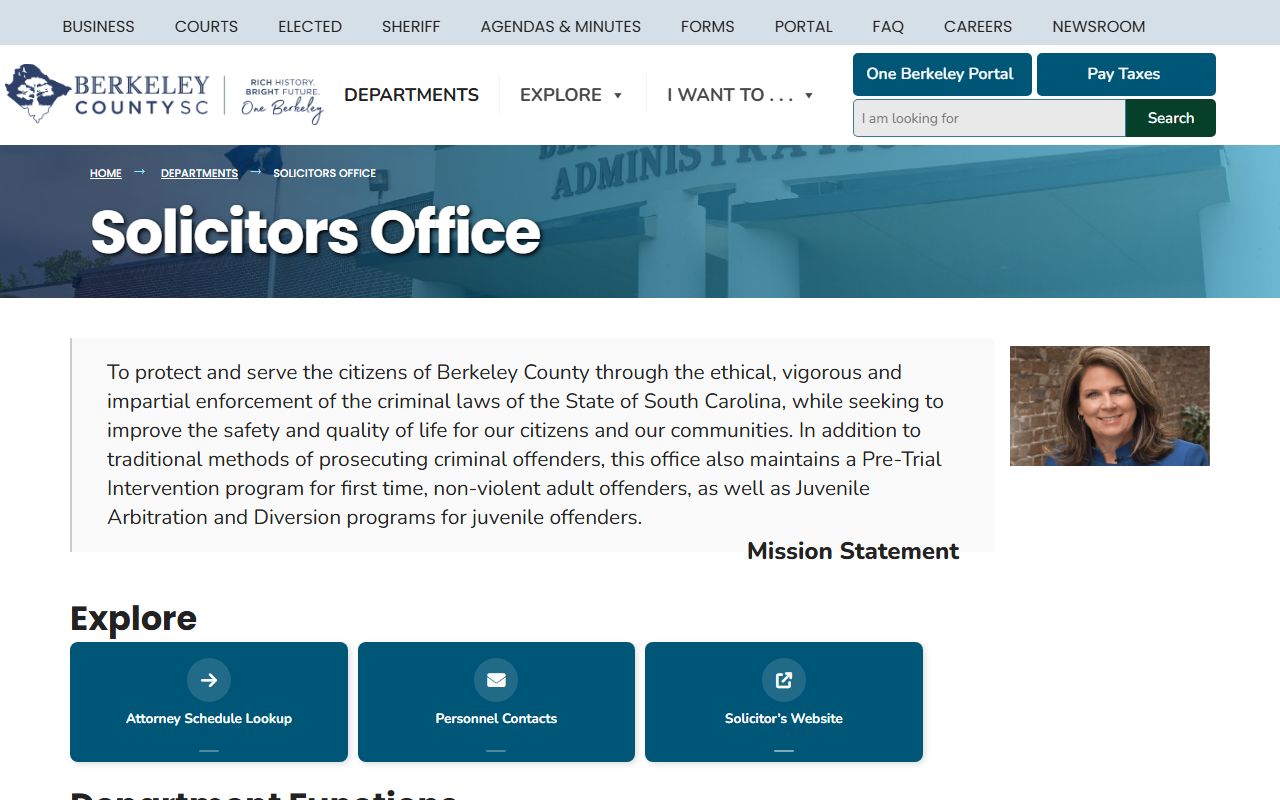
South Carolina uses the title Solicitor for the elected prosecutor. Berkeley County is in the Ninth Judicial Circuit with Charleston County. The Berkeley County Solicitor page says the Solicitor prosecutes all criminal cases in the Court of General Sessions, adjudicates juvenile criminal cases in Family Court, administers Pre-Trial Intervention, and administers Victim-Witness Assistance. That makes the Solicitor a key source for understanding why the court charge may not match the first jail charge.
The official Ninth Circuit Solicitor contact page identifies Scarlett A. Wilson as Solicitor and lists the Berkeley office at 300-B California Avenue, Moncks Corner, SC 29461. The Berkeley office phone is 843-719-4529, and the fax is 843-719-4588.
The county Solicitor page is a matched source for the prosecutor role in Berkeley County court records after arrest. The image below comes from that page.
Use the Solicitor information for prosecutor context, not as a substitute for the court public index.
Berkeley Charges After Jail Arrest
Charging documents are the bridge between the jail arrest and the court record. A complaint, information, or indictment can start or define the charge that appears in court. The exact document depends on the court, offense level, and prosecutor action.
| Document | Who Uses It | What It Means for the Court Record |
|---|---|---|
| Complaint | Law enforcement or prosecutor | Often starts a lower-level case or records the alleged offense after arrest. |
| Information | Prosecutor | States formal charges without relying on the wording first used at booking. |
| Indictment | Grand jury process | Common in serious General Sessions matters and may change the charge language. |
Do not treat a booking charge as the final word. The Solicitor may pursue a different charge, decline one charge, add another, or resolve a case through a program such as Pre-Trial Intervention when eligible.
Berkeley Charge Status Records
Charge status is where many court records after a jail arrest need close reading. A single arrest may create several counts, and each count can move in a different way. A bond entry does not equal a conviction, and a roster charge does not prove the prosecutor filed the same charge.
| Status | Plain Meaning | Reader Caution |
|---|---|---|
| Pending | The case or count has not reached a final disposition. | Check future hearing dates and bond conditions. |
| Amended or reduced | The charge changed from the first listed wording. | Compare the latest court entry to the jail roster charge. |
| Dismissed | The court record shows that charge did not proceed to conviction. | Other counts from the same arrest may still remain. |
| Nolle prosequi | The prosecutor chose not to pursue that charge. | Read the docket for the specific count and date. |
| Disposition entered | The court has recorded a final outcome. | Review sentence, fine, or probation entries separately. |
Berkeley Bond Court Records
Bond is part of the court record because it sets the release terms while a case is pending. S.C. Code Section 22-5-510 gives South Carolina magistrates authority to admit a person to bail for offenses not punishable by death or life imprisonment, with special rules for violent offenses. The statute also lists factors the court may weigh, including ties to the community, prior record, pending charges, incident reports, and flight risk.
| Bond Term | How It Works |
|---|---|
| Cash bond | Money is posted directly to secure release under the court's terms. |
| Surety bond | A licensed bond agent posts the bond for the defendant under separate terms. |
| Personal recognizance | Release is based on a promise to appear and obey conditions, not full cash posting. |
| No-bond hold | The person remains held because of charge type, a court order, or another hold. |
| Detainer | Another agency has requested custody or notice, which can delay release. |
Hill-Finklea states that release can take 1 to 4 hours after all documentation is received at the detention center. A posted bond may not release a person if another county warrant, probation or parole hold, federal custody issue, ICE detainer, or separate no-bond charge remains active.
Berkeley County Arrest Warrants
No official Berkeley County active warrant search URL was located in the research. The Sheriff's public links include inmate search, central records, incident reports, crime mapping, tips, and related services, but not a public warrant lookup. A warrant may still appear indirectly through a court case, a bond event, a failure-to-appear entry, or a jail booking once law enforcement executes it.
Official warrant-related channels include Berkeley County Magistrate Court, the Sheriff's Office general line at 843-719-4465, Hill-Finklea Booking at 843-719-4876, the main detention line at 843-719-4546, and the court case search for public case events.
Warrant caution: Confirm warrant status with the issuing court, attorney, or law enforcement office. Some warrant cases lead to immediate booking.
Berkeley Charges and Convictions
Charges and convictions are not the same thing. Court records after a Berkeley County jail arrest can show that a person was accused, released on bond, scheduled for a hearing, or had a charge dismissed without ever showing a conviction. A conviction requires a guilty plea, verdict, or other court result that counts as a finding of guilt.
| Point | Charge | Conviction |
|---|---|---|
| Stage | An accusation filed or maintained in court. | A final guilty result by plea or verdict. |
| Standard | Based on probable cause or formal charging review. | Based on proof beyond a reasonable doubt or a guilty plea. |
| Record use | Needs status context before conclusions are drawn. | Can carry sentence, fine, probation, or prison entries. |
| Roster link | May begin as a booking charge. | Does not appear just because a person was booked. |
Berkeley Sealed Expunged Records
South Carolina public-record law starts from access, but access is not unlimited. S.C. Code Title 30, Chapter 4 defines public records, gives inspection and copying rights, and also recognizes exemptions. Section 30-4-40 allows or requires withholding for some law enforcement, privacy, safety, juvenile, victim, and other protected information. That is why a court or jail record can be partly public and partly redacted.
| Record Result | Sealed | Expunged |
|---|---|---|
| Public visibility | Hidden from normal public access by court rule or order. | Removed or treated as cleared when the law allows it. |
| Best source | Ask the court that controls the case record. | Use the statutory expungement route and certified court documentation. |
| Common trigger | Protected case type, order, or legally restricted record. | Dismissal, discharge, not guilty result, or other eligible outcome. |
| Limit | Some agencies may retain restricted access. | Not every arrest or conviction qualifies. |
S.C. Code Section 17-1-60 is also relevant when an arrest or booking record, including a booking photograph, has to be removed or revised after a qualifying outcome. The statute targets publication and fee-based removal practices, and it requires qualifying requests to include proper written documentation.
Restricted Berkeley Court Records
Not every record connected to an arrest is open online. Juvenile-protected information, victim details, medical or mental-health records, some investigative materials, and safety-sensitive information may be withheld or redacted.
Important: Berkeley County custody and court entries can be incomplete or dated. Verify status with the court or agency that created the record.